
Dedicated Servers & Hosting
July 7, 2026

A high traffic dedicated server solves this by giving your site an entire physical machine of its own – no neighbours, no shared limits, no surprises. This guide explains exactly when high-traffic sites outgrow shared and VPS plans, how dedicated hosting fixes performance at the root, and what to look for when choosing a server in the UAE.
A high-traffic website is any site whose visitor volume, concurrent users, or resource demand consistently pushes its hosting plan toward its limits. There is no single magic number – 50,000 monthly visitors on a heavy e-commerce store can strain a server far more than 200,000 views on a lightweight blog. What matters is the load your pages place on server resources, not just the headline traffic figure.
In practice, most sites feel the pressure once they hit a combination of the following: tens of thousands of visits per day, hundreds of simultaneous users during peak hours, database-heavy pages (product catalogues, member portals, dynamic search), or recurring traffic spikes from campaigns, sales, or seasonal demand. Media-rich pages, large product images, and real-time features all multiply the strain.
If your site checks two or more of those boxes, you are no longer a typical small-website tenant – and the shared or entry-level hosting built for that tenant will increasingly work against you.
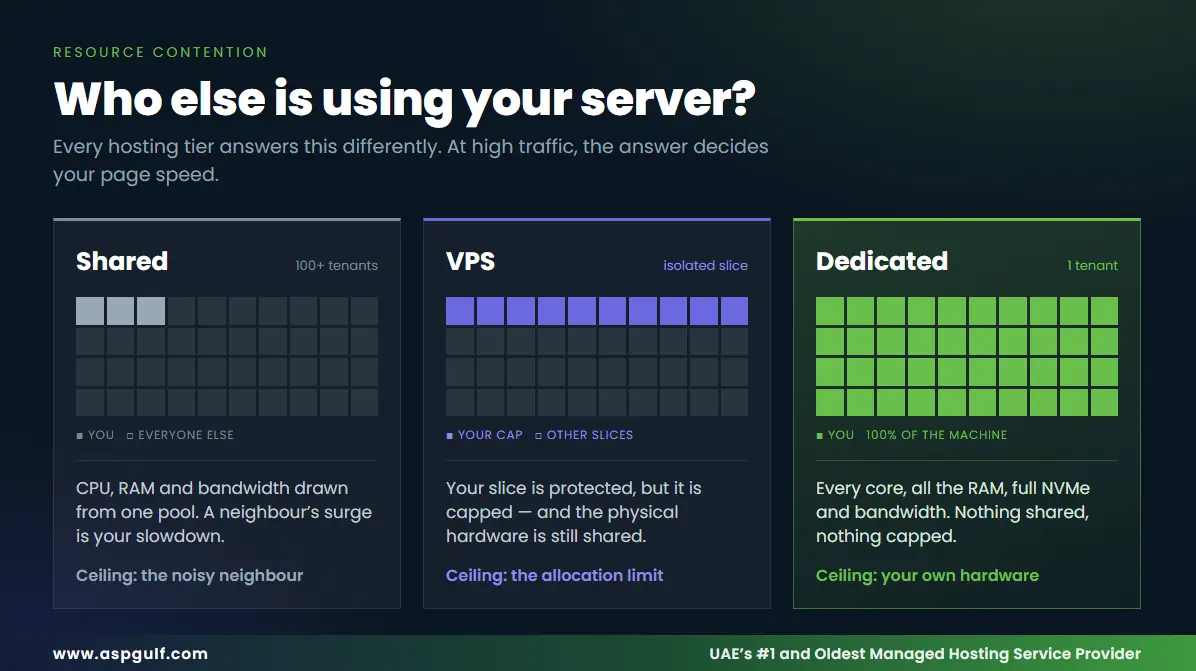
Shared and VPS hosting break under heavy traffic because you are always competing for a finite pool of resources you do not fully control. On shared hosting, dozens or hundreds of websites live on one server and draw from the same CPU, RAM, and bandwidth. When a neighbouring site has a traffic surge or a runaway script, your site slows down – the classic “noisy neighbour” problem.
VPS hosting improves on this by partitioning a server into isolated virtual slices, and for growing sites it is a genuine step up. But a VPS still shares the underlying physical hardware, and its allocated resources are capped. Push past those limits during a peak and you hit a ceiling – throttling, sluggish response times, or outright errors. If you are weighing the two tiers, our breakdown of dedicated server vs VPS hosting walks through where each one fits.
The core issue is the same in both cases: contention. Your website’s performance depends on resources shared with, or capped below, what a demanding site actually needs. For a high-traffic site, that is a structural problem – and no amount of caching fully solves it. Businesses that have already outgrown budget plans often start by comparing a stronger Dubai VPS server before committing to a full dedicated machine.
A dedicated server gives you an entire physical machine reserved for your website alone – every CPU core, all the RAM, the full storage, and the complete bandwidth allocation are yours, with nothing shared and nothing capped by a virtualisation layer. This single fact is what makes dedicated hosting the natural home for high-traffic sites.
Concretely, that isolation translates into:
This is precisely why enterprises and high-demand platforms in the region lean on dedicated server hosting in the UAE – the resources are guaranteed, and the environment is fully yours to optimise.
Dedicated servers improve website performance by removing the two biggest drags on speed at scale: resource contention and hardware limits. With an entire machine at your disposal, pages render faster, database queries resolve quicker, and response times stay stable even as concurrent users climb. For any high-traffic site, this is the heart of website performance hosting.
Speed is not a vanity metric – it directly shapes revenue and rankings. Google’s own research has long shown that as page load time rises from one to three seconds, the probability that a visitor bounces climbs sharply, and that a majority of mobile users abandon pages that take more than three seconds to load. Faster server response also feeds directly into Core Web Vitals, which influence search visibility.
A dedicated server lets you attack performance from every angle: server-level caching, a tuned web server (NGINX, Apache, or LiteSpeed), optimised database configuration, and the freedom to run the exact PHP settings your application needs – the kind of tuning we cover in our guide to configuring PHP for optimal performance. On shared hosting, most of these levers are locked. For sites that want to push performance further still, ongoing server optimization services keep the machine tuned as traffic and workloads evolve.
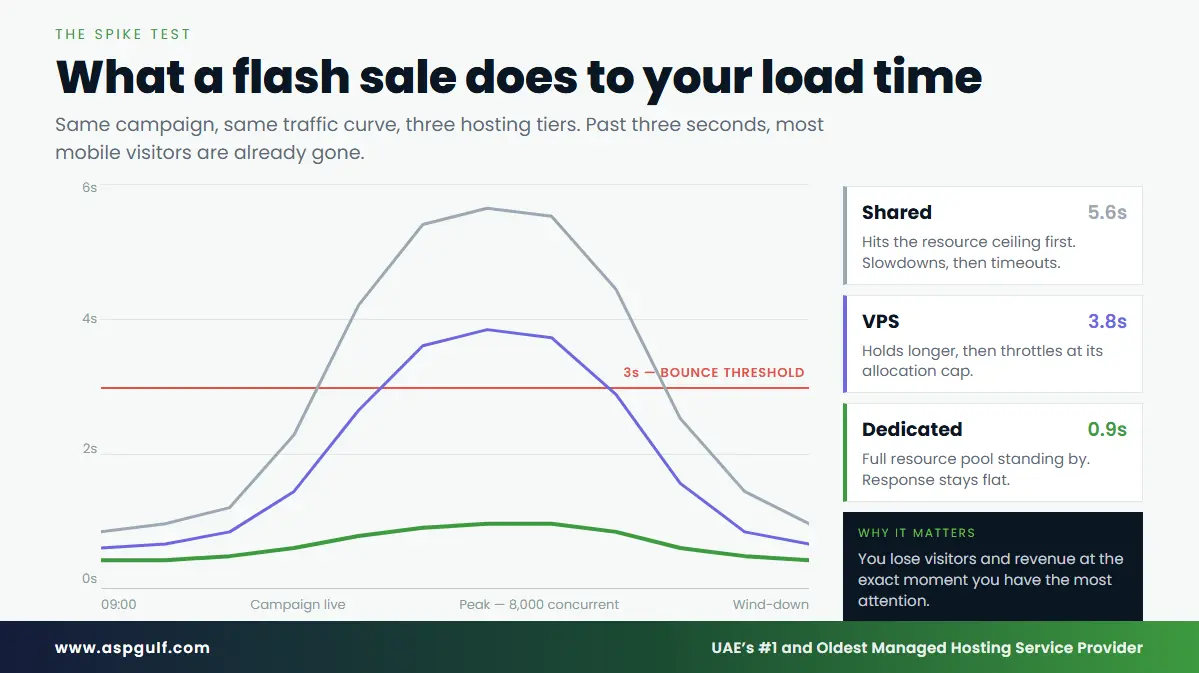
Dedicated servers handle traffic spikes far better than shared or entry-level hosting because the full resource pool is standing by, ready for peak demand rather than rationed across many sites. When a campaign lands, a product drops, or a seasonal rush hits, the server has the headroom to absorb thousands of simultaneous visitors without collapsing.
The moments that matter most are exactly the ones cheaper hosting handles worst: a viral post, a flash sale, a Ramadan or year-end shopping surge, or a press mention that sends a wall of traffic in minutes. On a shared plan these events trigger slowdowns or downtime – the worst possible outcome, since you lose visitors and revenue at the precise moment you have the most attention.
A dedicated environment also gives you room to engineer for scale: load balancing across services, generous caching layers, and the option to add resources or servers as you grow. High-traffic e-commerce stores in particular benefit from this stability, which is why many move to dedicated hosting for e-commerce workloads before their busiest trading periods.
A dedicated server strengthens security by giving you an isolated environment with no other tenants sharing your operating system, files, or vulnerabilities – a critical advantage for high-traffic sites that are bigger, more visible targets. You control the firewall rules, the patching schedule, and every layer of the security stack.
That isolation matters because high-traffic sites attract more than visitors. Larger audiences mean larger attack surfaces: DDoS attempts, bot floods, and intrusion attempts all scale with visibility. On a dedicated server you can deploy hardened firewalls, DDoS mitigation, and intrusion detection tuned to your specific application, rather than accepting a one-size-fits-all shared configuration. Layering in dedicated network security services closes the gap between raw performance and true resilience.
For UAE businesses, compliance is just as important as raw protection. Regulations around data residency and TDRA requirements mean many organisations must keep data hosted within the country. Choosing a dedicated server in a UAE-based, Tier III data centre keeps your data on local soil, simplifies compliance, and – as a bonus – cuts latency for your regional audience. Businesses with strict control or hardware-ownership needs sometimes go further and explore colocation hosting for full physical ownership within a managed facility.
For sustained high traffic, a dedicated server delivers the most consistent raw performance, a VPS suits steady mid-range growth, and cloud hosting shines when traffic is highly unpredictable and you value on-demand elasticity over guaranteed hardware. The right choice depends on the shape of your traffic and your workload.
A quick way to frame the decision:
Many high-traffic businesses ultimately run a blend – a dedicated server for the core workload, with cloud server capacity for burst demand. If you are still deciding between tiers, our guide on choosing between a dedicated server and a VPS compares them side by side.
The difference is simple: with managed dedicated hosting, your provider handles setup, monitoring, patching, security, and maintenance, while unmanaged hosting hands you the raw server and leaves all administration to your own team. For most high-traffic businesses, managed hosting is the practical choice.
Unmanaged dedicated servers offer maximum control and a lower base price, but they assume you have in-house expertise to run the OS, secure the stack, apply updates, and respond to incidents at any hour. If that describes your team, our overview of unmanaged dedicated server hosting lays out what you take on.
Managed hosting removes that operational burden. A capable provider keeps the server patched, monitored around the clock, secured, and optimised – so your team focuses on the business, not the infrastructure. This is where managed hosting services and dedicated server management pay for themselves, especially for high-traffic sites where downtime is expensive and response speed is everything.
You have likely outgrown your current hosting when performance problems keep recurring no matter how much you optimise – a clear signal that the constraint is the server itself, not your website. Watch for these tell-tale signs:
If several of these sound familiar, you have reached the point where a dedicated server stops being an upgrade and becomes a necessity. The same thresholds apply whether you run a high-traffic e-commerce store or a busy content platform on WordPress hosting.
Choosing the right high-traffic dedicated server comes down to matching hardware, location, support, and scalability to your actual workload – not just buying the biggest box available. For UAE businesses, a few factors deserve particular attention.
Prioritise these when comparing providers:
With more than 25 years operating data centres in Dubai, ASPGulf delivers exactly this combination – high-performance dedicated server hosting in the UAE, hosted locally, fully managed, and built to keep high-traffic sites fast and online.
A high-traffic dedicated server is a physical server reserved entirely for one website or business, with all CPU, RAM, storage, and bandwidth dedicated to handling large volumes of visitors and heavy resource demand. Because nothing is shared, it delivers consistent performance even during peak traffic.
There is no fixed number, but sites that regularly serve tens of thousands of daily visits, run resource-heavy or database-driven pages, or experience frequent traffic spikes typically outgrow shared and entry-level VPS hosting. If you hit resource limits or slow down during peaks, it is time to consider a dedicated server.
Yes. Because a dedicated server has no resource contention and lets you tune caching, the web server, and the database freely, pages load faster and response times stay stable under load. Faster loading also supports better Core Web Vitals and search rankings.
It depends on your traffic pattern. Dedicated servers offer the most consistent raw performance for sustained high traffic, while cloud hosting is better for highly unpredictable, spiky demand. Many high-traffic businesses combine both – a dedicated core with cloud capacity for bursts.
Pricing depends on hardware specifications, bandwidth, and whether the server is managed or unmanaged. UAE-hosted, fully managed dedicated servers are priced in AED and scale with the resources you need. Contact ASPGulf for a tailored quote.
Choose managed hosting if you want your provider to handle setup, security, monitoring, and maintenance so your team can focus on the business. Unmanaged hosting offers a lower base cost and full control but requires in-house server-administration expertise.
Yes. A dedicated server keeps its full resource pool ready for peak demand, so it can absorb sudden surges such as flash sales, viral posts, and seasonal rushes far better than shared hosting, which often slows or crashes at exactly those moments.










A high traffic dedicated server solves this by giving your site an entire physical machine…
Read more
PHP powers nearly 75% of all websites with a known server-side language, including WordPress, Magento,…
Read more
Data is the backbone of every business in the UAE – from customer records and…
Read moreFrom securing your digital landscape with our top-notch Security Risk Assessment Services to optimizing your cloud journey with certified expertise as a Microsoft Cloud Solution Provider offering Microsoft Azure Services and cutting-edge Office 365 Email Hosting solutions. Elevate your operations with the flexibility of Cloud Server options, explore the efficiency of Multicloud Services and the privacy of Private Cloud solutions. Extend your reach with the reliability of Public Cloud offerings, including Amazon Web Services, Oracle Cloud Managed Service Provider, and Google Cloud Hosting Services. Ensure seamless web hosting with options like Dubai VPS Server, trusted Colocation Hosting Providers, and efficient Shared Web Hosting services. Streamline your communication with our Hosted Call Center Service and experience the power of dedicated resources through Dedicated Server UAE, Windows Server Hosting, and efficient WordPress Hosting. Explore the versatility of Linux Hosting with cPanel and optimize your business processes with Hosted Microsoft Dynamics. Our commitment extends to professional expertise with IT Professional Services, reliable Technical Services, secure Data Replication Services, and robust Data Protection Services. Trust in our capabilities with a state-of-the-art Data Center in Dubai, UAE.
As your trusted Managed Security Service Provider, we offer top-tier services such as Digital Security Forensics, efficient Cyber Incident Response, robust Managed Firewall Services, and reliable Recover-as-a-Service. Ensure the continuous health of your operations with our proactive Remote Monitoring and Management