Cloud Security Best Practices for UAE Businesses: The Complete Guide

As UAE businesses accelerate cloud adoption, security threats are evolving just as fast. From ransomware attacks to data breaches and compliance violations, the risks are significant. This comprehensive guide covers essential cloud security best practices to protect your data, maintain compliance, and secure your business in the cloud.

13 min read 2,547 words Updated: February 4, 2026 105 views

Cloud computing has transformed how UAE businesses operate. From startups to enterprises, organizations are leveraging cloud server solutions for agility, scalability, and cost efficiency. However, this digital transformation brings new security challenges that require a strategic, comprehensive approach.

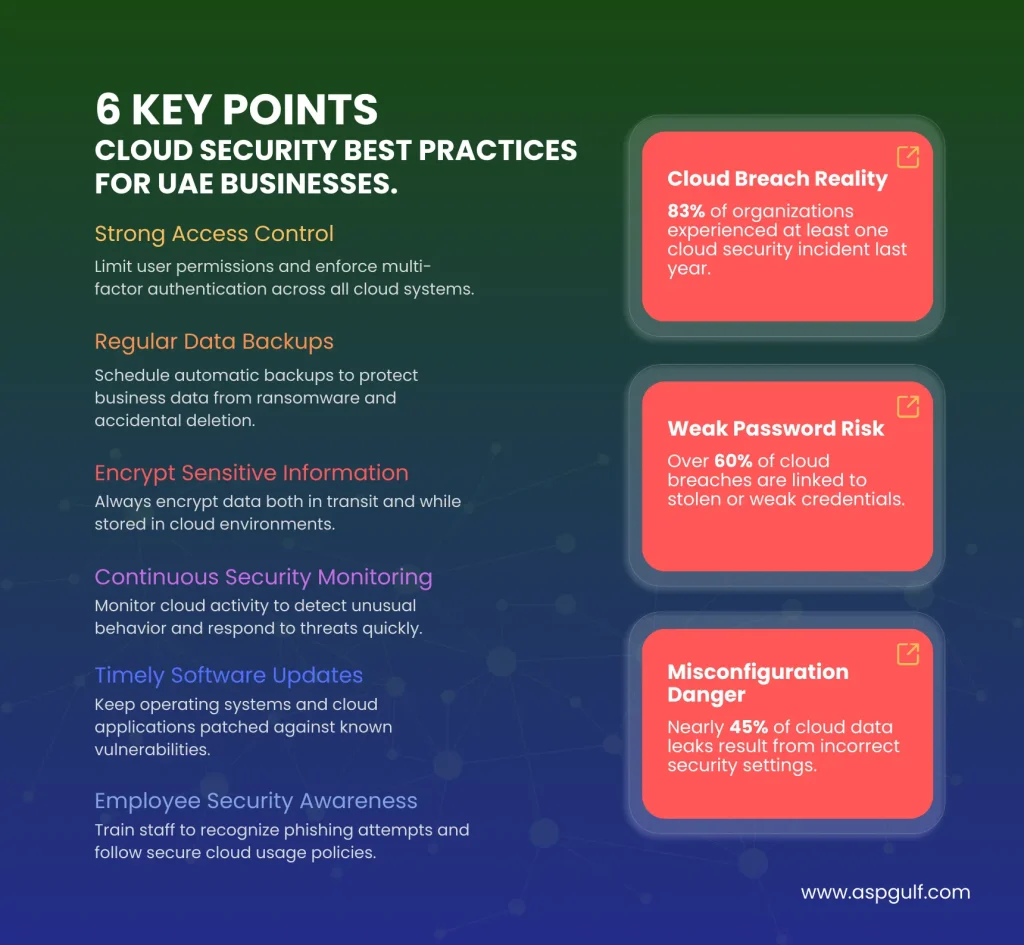
According to recent reports, 94% of enterprises use cloud services, yet 80% have experienced at least one cloud security incident in the past year. For UAE business cloud security, the stakes are even higher with strict data residency requirements and evolving cybersecurity regulations. This guide provides actionable cloud security best practices tailored for the UAE market.

Understanding the Cloud Security Landscape in UAE

Before implementing cloud security best practices, it’s essential to understand the unique challenges facing UAE businesses:

UAE-Specific Security Considerations

Regulatory Environment

  • UAE Cybersecurity Council: National cybersecurity standards and frameworks
  • Data Protection Laws: Federal Decree-Law No. 45 of 2021 on Personal Data Protection
  • Sector Regulations: Central Bank, healthcare, and telecommunications requirements
  • Free Zone Requirements: DIFC, ADGM, and other free zone data handling rules

Data Residency Requirements

  • Certain data types must remain within UAE borders
  • Government and financial sector data often requires local storage
  • Healthcare data subject to specific handling requirements
  • Cross-border data transfer restrictions apply

Regional Threat Landscape

  • Middle East faces increasing cyber attacks
  • Financial sector particularly targeted
  • State-sponsored threats affecting critical infrastructure
  • Ransomware attacks growing in frequency and sophistication

The Shared Responsibility Model

Understanding who is responsible for what is fundamental to cloud security best practices:

Cloud Provider Responsibilities

  • Physical security of data centers
  • Network infrastructure protection
  • Hypervisor and virtualization security
  • Service availability and resilience

Customer Responsibilities

  • Data classification and protection
  • Identity and access management
  • Application security
  • Network configuration and firewall rules
  • Encryption and key management
  • Compliance and regulatory adherence

Many security breaches occur because organizations misunderstand this shared model. Professional cloud security management helps ensure both sides of this equation are properly addressed.

Essential Cloud Security Best Practices

Implement these foundational cloud security best practices to protect your UAE business:

1. Implement Strong Identity and Access Management (IAM)

IAM identity access management is the cornerstone of cloud security:

Multi-Factor Authentication (MFA)

  • Enforce MFA everywhere: Require MFA for all user accounts, especially privileged users
  • Use strong factors: Hardware tokens or authenticator apps over SMS
  • Conditional MFA: Require additional factors for sensitive operations or unusual access patterns
  • No exceptions: Even “temporary” accounts should have MFA

Least Privilege Access

  • Minimum permissions: Grant only the access needed to perform job functions
  • Just-in-Time (JIT) access: Provide elevated privileges only when needed, automatically revoke
  • Regular access reviews: Quarterly reviews of who has access to what
  • Separation of duties: Prevent single individuals from having excessive control

Identity Governance

  • Centralized identity management: Single source of truth for all identities
  • Automated provisioning/deprovisioning: Access granted and revoked based on HR systems
  • Privileged Access Management (PAM): Extra controls for administrative accounts
  • Service account management: Track and secure non-human identities

2. Encrypt Data Everywhere

Encryption is non-negotiable for UAE business cloud security:

Data at Rest

  • Enable encryption by default: All storage should be encrypted
  • Use strong algorithms: AES-256 is the current standard
  • Customer-managed keys: Maintain control over encryption keys where possible
  • Database encryption: Encrypt sensitive database fields and tables

Data in Transit

  • TLS 1.3: Use the latest transport layer security protocol
  • Certificate management: Proper SSL/TLS certificate handling
  • API encryption: All API communications encrypted
  • Internal traffic: Encrypt traffic between services, not just external

Data in Use

  • Confidential computing: Consider for highly sensitive workloads
  • Secure enclaves: Process sensitive data in isolated environments
  • Tokenization: Replace sensitive data with non-sensitive tokens

Key Management

  • Hardware Security Modules (HSM): Secure key storage
  • Key rotation: Regular rotation of encryption keys
  • Separation of keys and data: Don’t store keys with encrypted data
  • Backup keys securely: Ensure key recovery capabilities

3. Secure Network Architecture

Proper network design is essential. Consider network security services for comprehensive protection:

Network Segmentation

  • Virtual networks: Isolate workloads in separate virtual networks
  • Subnets: Further segment based on function and sensitivity
  • Micro-segmentation: Fine-grained isolation between workloads
  • Network security groups: Control traffic at the virtual NIC level

Firewall Configuration

  • Default deny: Block all traffic except explicitly allowed
  • Layered firewalls: Multiple layers of firewall protection
  • Application-aware: Use next-generation firewalls that understand applications
  • Regular rule review: Audit and clean up firewall rules quarterly

Managed firewall services ensure your firewall configurations remain optimized and secure.

Zero Trust Network Access

  • Verify everything: No implicit trust based on network location
  • Continuous validation: Ongoing verification of users and devices
  • Context-aware access: Consider user, device, location, and behavior
  • Encrypt all traffic: Even internal network traffic

4. Implement Comprehensive Endpoint Security

Endpoint security solutions protect all devices accessing cloud resources:

Endpoint Detection and Response (EDR)

  • Real-time monitoring: Continuous surveillance of endpoint activity
  • Behavioral analysis: Detect anomalous behavior indicating threats
  • Automated response: Isolate compromised devices automatically
  • Forensic capabilities: Investigate incidents with detailed logging

Device Management

  • Mobile Device Management (MDM): Control corporate and BYOD devices
  • Device compliance: Only allow compliant devices to access resources
  • Remote wipe: Ability to erase data from lost or stolen devices
  • Patch management: Keep all devices updated

5. Continuous Monitoring and Threat Detection

You can’t protect what you can’t see. Partner with a managed security service provider for comprehensive monitoring:

Security Information and Event Management (SIEM)

  • Centralized logging: Collect logs from all cloud services and applications
  • Real-time analysis: Correlate events to detect threats
  • Alert management: Prioritized alerts for security teams
  • Compliance reporting: Generate reports for regulatory requirements

Cloud-Native Security Tools

  • Cloud Security Posture Management (CSPM): Detect misconfigurations
  • Cloud Workload Protection Platform (CWPP): Secure cloud workloads
  • Cloud Access Security Broker (CASB): Visibility into SaaS usage
  • Cloud Infrastructure Entitlement Management (CIEM): Manage cloud permissions

Threat Intelligence

  • Threat feeds: Real-time information about emerging threats
  • Regional intelligence: Threats specific to Middle East and UAE
  • Industry-specific threats: Intelligence relevant to your sector
  • Proactive hunting: Actively search for hidden threats

6. Secure Development and DevSecOps

Security must be built into applications from the start:

Secure Development Practices

  • Security training: Developers trained in secure coding
  • Code reviews: Security-focused code review processes
  • SAST: Static Application Security Testing in CI/CD
  • DAST: Dynamic Application Security Testing before deployment

Container and Kubernetes Security

  • Image scanning: Scan container images for vulnerabilities
  • Runtime protection: Monitor container behavior in production
  • Pod security: Enforce Kubernetes security policies
  • Secrets management: Securely handle credentials in containers

Infrastructure as Code (IaC) Security

  • Template scanning: Check IaC templates for security issues
  • Policy as code: Enforce security policies automatically
  • Version control: Track all infrastructure changes
  • Drift detection: Identify unauthorized configuration changes

Let Us Manage Your IT

So You Can Focus on Growth

Data Protection and Privacy Compliance

UAE business cloud security must address data protection requirements:

Data Classification

Categorize data based on sensitivity:

Classification Levels

  • Public: Information freely available
  • Internal: Business information not for public release
  • Confidential: Sensitive business data requiring protection
  • Restricted: Highly sensitive data (PII, financial, healthcare)

Classification Actions

  • Discovery: Identify where sensitive data exists
  • Labeling: Tag data with appropriate classification
  • Policy enforcement: Apply controls based on classification
  • Monitoring: Track how classified data is accessed and used

Data Loss Prevention (DLP)

  • Content inspection: Scan data for sensitive content
  • Policy enforcement: Block unauthorized data transfers
  • User notification: Educate users about policy violations
  • Incident reporting: Track and investigate DLP events

UAE Compliance Requirements

Personal Data Protection Law

  • Consent management: Proper collection and storage of consent
  • Data subject rights: Ability to respond to access and deletion requests
  • Breach notification: Timely reporting of data breaches
  • Cross-border transfers: Compliance with transfer restrictions

Sector-Specific Compliance

  • Financial services: Central Bank of UAE requirements
  • Healthcare: Health data protection regulations
  • Government: National security and data handling requirements
  • Telecommunications: TRA regulations

Regular security risk assessment services help ensure ongoing compliance with these requirements.

Cloud Security Architecture

Proper architecture is fundamental to cloud security best practices:

Defense in Depth

Layer security controls throughout your environment:

Layer 1: Perimeter Security

  • Web Application Firewall (WAF)
  • DDoS protection
  • API gateway security
  • Content Delivery Network (CDN) security

Layer 2: Network Security

  • Network segmentation
  • Firewalls and security groups
  • Intrusion detection/prevention
  • VPN and private connectivity

Layer 3: Compute Security

  • Server hardening
  • Vulnerability management
  • Anti-malware protection
  • Runtime protection

Layer 4: Application Security

  • Secure coding practices
  • Input validation
  • Authentication and authorization
  • Session management

Layer 5: Data Security

  • Encryption at rest and in transit
  • Data masking and tokenization
  • Database security
  • Backup and recovery

Multi-Cloud Security

For organizations using multiple cloud providers:

  • Unified visibility: Single view across all cloud environments
  • Consistent policies: Apply same security standards everywhere
  • Centralized identity: Federated identity across clouds
  • Cross-cloud networking: Secure connectivity between clouds

Hybrid Cloud Security

Connecting on-premises with private cloud and public cloud:

  • Secure connectivity: VPN or dedicated connections
  • Consistent security: Same policies across environments
  • Identity integration: Unified authentication
  • Data placement: Keep sensitive data where required

Incident Response and Disaster Recovery

Prepare for security incidents as part of cloud security best practices:

Incident Response Planning

Response Team

  • Define roles: Who does what during an incident
  • Contact lists: Internal teams, vendors, authorities
  • Escalation paths: When and how to escalate
  • External resources: Forensics, legal, PR support

Response Procedures

  • Detection: How incidents are identified
  • Containment: Steps to limit damage
  • Eradication: Removing the threat
  • Recovery: Restoring normal operations
  • Lessons learned: Post-incident review and improvement

Communication Plan

  • Internal communication: Keeping stakeholders informed
  • Customer notification: If customer data affected
  • Regulatory reporting: Meeting breach notification requirements
  • Media response: Managing public communications

Business Continuity and Disaster Recovery

Backup Strategies

  • 3-2-1 rule: 3 copies, 2 media types, 1 offsite
  • Immutable backups: Protect against ransomware
  • Regular testing: Verify backups are recoverable
  • Geographic distribution: Backups in multiple regions

Recovery Planning

  • RTO and RPO: Define recovery time and point objectives
  • Failover procedures: Documented steps for recovery
  • DR testing: Regular disaster recovery drills
  • Continuous improvement: Update plans based on tests and incidents

Security Governance and Risk Management

Establish governance frameworks for UAE business cloud security:

Security Policies

Essential Policies

  • Cloud security policy: Overall cloud security requirements
  • Access control policy: Who can access what
  • Data protection policy: How data is handled and protected
  • Acceptable use policy: How cloud services can be used
  • Incident response policy: How to handle security incidents

Policy Management

  • Regular review: Update policies at least annually
  • Communication: Ensure all employees understand policies
  • Training: Regular security awareness training
  • Enforcement: Consequences for policy violations

Risk Management

Risk Assessment Process

  • Asset identification: What needs protection
  • Threat identification: What could harm assets
  • Vulnerability assessment: Weaknesses that could be exploited
  • Impact analysis: Consequences of successful attacks
  • Risk prioritization: Focus on highest risks first

Risk Treatment

  • Mitigate: Implement controls to reduce risk
  • Transfer: Insurance or contractual transfer
  • Accept: Acknowledge and monitor low risks
  • Avoid: Eliminate the risk source

Vendor Management

Cloud Provider Assessment

  • Security certifications: ISO 27001, SOC 2, CSA STAR
  • Compliance capabilities: Support for your regulatory requirements
  • Data handling: How provider handles your data
  • Incident response: Provider’s breach notification process

Ongoing Monitoring

  • SLA monitoring: Track provider performance
  • Security updates: Stay informed of provider changes
  • Audit reports: Review provider audit reports annually
  • Exit planning: Know how to leave if needed

Security Awareness and Training

People are often the weakest link. Address this with training:

Security Awareness Program

Training Topics

  • Phishing awareness: Recognizing and reporting phishing
  • Password security: Creating and managing strong passwords
  • Data handling: Proper treatment of sensitive information
  • Social engineering: Recognizing manipulation attempts
  • Incident reporting: When and how to report security concerns

Training Methods

  • Regular training: Beyond annual compliance requirements
  • Phishing simulations: Test and reinforce awareness
  • Role-specific training: Additional training for high-risk roles
  • New employee onboarding: Security training from day one

Building Security Culture

  • Leadership commitment: Security championed from the top
  • Positive reinforcement: Recognize security-conscious behavior
  • Open communication: Encourage reporting without fear
  • Continuous improvement: Learn and adapt based on incidents

Cloud Security Checklist for UAE Businesses

Use this checklist to assess your cloud security best practices implementation:

Identity and Access Management

  • Multi-factor authentication enabled for all users
  • Least privilege access implemented
  • Regular access reviews conducted
  • Privileged accounts properly managed
  • Service accounts inventoried and secured

Data Protection

  • Data classified by sensitivity
  • Encryption at rest enabled
  • Encryption in transit enforced
  • Key management procedures documented
  • DLP controls implemented

Network Security

  • Network segmentation implemented
  • Firewall rules reviewed and optimized
  • VPN/private connectivity for sensitive access
  • DDoS protection in place
  • WAF protecting web applications

Monitoring and Detection

  • Centralized logging enabled
  • SIEM deployed and configured
  • 24/7 monitoring in place
  • Threat intelligence integrated
  • Alert thresholds tuned

Incident Response

  • Incident response plan documented
  • Response team defined and trained
  • Tabletop exercises conducted
  • Communication plans ready
  • Forensic capabilities available

Compliance

  • UAE data protection requirements met
  • Industry-specific regulations addressed
  • Regular compliance assessments
  • Audit trail maintained
  • Data residency requirements satisfied

Backup and Recovery

  • Regular backups configured
  • Backups tested for recoverability
  • Offsite/cross-region backup storage
  • Immutable backups for ransomware protection
  • DR plan documented and tested

Common Cloud Security Mistakes to Avoid

Learn from others’ mistakes when implementing UAE business cloud security:

1. Misconfigured Cloud Services

The Problem: Open storage buckets, excessive permissions, default configurations

The Solution: Regular configuration audits, cloud security posture management tools, infrastructure as code with security checks

2. Inadequate Access Controls

The Problem: Over-privileged users, shared credentials, lack of MFA

The Solution: Implement least privilege, enforce MFA everywhere, regular access reviews

3. Insufficient Logging and Monitoring

The Problem: Can’t detect breaches if you’re not watching

The Solution: Enable comprehensive logging, implement SIEM, 24/7 monitoring

4. Neglecting Encryption

The Problem: Data exposed if storage is compromised

The Solution: Encrypt everything – at rest, in transit, and consider data in use

5. Ignoring the Shared Responsibility Model

The Problem: Assuming the cloud provider handles all security

The Solution: Understand and fulfill your security responsibilities

6. Lack of Incident Response Planning

The Problem: Chaos and delays when incidents occur

The Solution: Document, practice, and regularly update incident response plans

7. Shadow IT and Uncontrolled Cloud Usage

The Problem: Employees using unauthorized cloud services

The Solution: CASB visibility, clear policies, approved alternatives for common needs

ASPGulf Cloud Security Solutions

ASPGulf provides comprehensive cloud security best practices implementation for UAE businesses:

Our Cloud Security Services

Why Choose ASPGulf for Cloud Security?

  • 25+ Years UAE Experience: Deep understanding of local business and regulatory requirements
  • Local Compliance Expertise: Knowledge of UAE data protection laws and sector regulations
  • 24/7 Security Operations: Round-the-clock monitoring and incident response
  • Certified Security Professionals: Team with industry-leading security certifications
  • Multi-Cloud Expertise: Security across AWS, Azure, Google Cloud, and private cloud
  • Managed IT Services Integration: Security integrated with comprehensive IT management

Conclusion: Building a Secure Cloud Foundation

Implementing cloud security best practices is not optional for UAE businesses – it’s essential for protecting your data, maintaining customer trust, and meeting regulatory requirements. The key principles to remember:

  • Identity is the new perimeter: Strong IAM with MFA is foundational
  • Encrypt everything: Data at rest, in transit, and consider data in use
  • Defense in depth: Multiple layers of security controls
  • Continuous monitoring: You can’t protect what you can’t see
  • Prepare for incidents: Have plans ready before you need them
  • Compliance is minimum: Go beyond checkbox compliance for real security
  • People matter: Train and empower your employees

UAE business cloud security requires ongoing attention and adaptation as threats evolve. By implementing these best practices and partnering with experienced security providers, you can confidently leverage cloud computing while protecting your organization.

Ready to strengthen your cloud security? Contact ASPGulf for a comprehensive security risk assessment. Our experts will evaluate your current cloud security posture and recommend improvements tailored to your UAE business needs. Call us today or explore our cloud security services to get started.

Dedicated Server UAE

Get Free Migration and 24/7 Support

Read more

VPS Servers in Dubai

Get Your VPS Server Hosting In 24 Hrs

Read more

Managed IT Services

Managed IT Services in UAE

Read more

On-premises Managed Services

Partner with a team of experts in UAE

Read more

Managed Hosting Services

ISO Certified managed hosting services provider

Read more

Cloud Hosting Services

Performance, scalability, and round-the-clock support

Read more

Featured Posts


Microsoft Cloud Solutions
February 5, 2026
Cloud Security & Compliance
February 4, 2026
Managed Services & IT Support
February 3, 2026
Dedicated Servers & Hosting
February 2, 2026
Cloud Computing & Infrastructure
January 27, 2026
Server Setup & Configuration
January 16, 2026
Server Setup & Configuration
January 15, 2026
Dedicated Hosting
January 7, 2026

Trending


Link copied to clipboard!

Managed Hosting Services Portfolio

What we think

Testimonials

CUSTOMER REVIEWS

Empower your business with our comprehensive range of IT solutions!
From securing your digital landscape with our top-notch Security Risk Assessment Services to optimizing your cloud journey with certified expertise as a Microsoft Cloud Solution Provider offering Microsoft Azure Services and cutting-edge Office 365 Email Hosting solutions. Elevate your operations with the flexibility of Cloud Server options, explore the efficiency of Multicloud Services and the privacy of Private Cloud solutions. Extend your reach with the reliability of Public Cloud offerings, including Amazon Web Services, Oracle Cloud Managed Service Provider, and Google Cloud Hosting Services. Ensure seamless web hosting with options like Dubai VPS Server, trusted Colocation Hosting Providers, and efficient Shared Web Hosting services. Streamline your communication with our Hosted Call Center Service and experience the power of dedicated resources through Dedicated Server UAE, Windows Server Hosting, and efficient WordPress Hosting. Explore the versatility of Linux Hosting with cPanel and optimize your business processes with Hosted Microsoft Dynamics. Our commitment extends to professional expertise with IT Professional Services, reliable Technical Services, secure Data Replication Services, and robust Data Protection Services. Trust in our capabilities with a state-of-the-art Data Center in Dubai, UAE.

As your trusted Managed Security Service Provider, we offer top-tier services such as Digital Security Forensics, efficient Cyber Incident Response, robust Managed Firewall Services, and reliable Recover-as-a-Service. Ensure the continuous health of your operations with our proactive Remote Monitoring and Management

Let us guide you to technological excellence and secure your path to success.
×